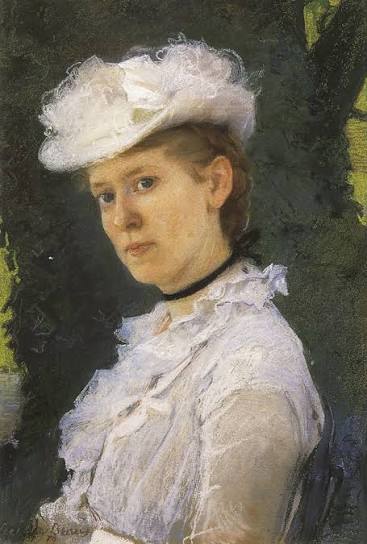
 Maud Darwin (July 27, 1861 - February 6, 1947), born Martha Haskins du Puy on July 27, 1861, in Pennsylvania, was a prominent American-born socialite, intellectual, and
reformer who became a central figure in Cambridge academic society.
Maud Darwin (July 27, 1861 - February 6, 1947), born Martha Haskins du Puy on July 27, 1861, in Pennsylvania, was a prominent American-born socialite, intellectual, and
reformer who became a central figure in Cambridge academic society.Queer Places:
St. Mary and St. Michael Churchyard, 1a Grantchester Rd, Trumpington, Cambridge CB2 9LH, United Kingdom
Maud Darwin (July 27, 1861 - February 6, 1947), born Martha Haskins du Puy on July 27, 1861, in Pennsylvania, was a prominent American-born socialite, intellectual, and
reformer who became a central figure in Cambridge academic society.
Born to Charles Meredith du Puy and Ellen Maria Reynolds, she grew up in a well-established American family. Her life took a transatlantic turn when she visited her aunt, Caroline Jebb (wife of the classicist Richard Claverhouse Jebb), in England. During her travels in Italy, she met Sir George Darwin—an astronomer and son of the famed naturalist Charles Darwin—whom she married in Erie, Pennsylvania, in 1884.
The couple settled at Newnham Grange in Cambridge in 1885, where they raised five children: the artist Gwen Raverat, physicist Charles Galton Darwin, Margaret Elizabeth Keynes (who married Geoffrey Langdon Keynes, brother of John Maynard Keynes), William Robert Darwin, and an infant son who died shortly after birth. As the wife of an influential Cambridge professor, Maud integrated seamlessly into elite intellectual circles, though she maintained her distinct, progressive American outlook throughout her life.
In 1890, Maud became a founding or early member of the prestigious Ladies Dining Society, an exclusive and intellectually rigorous group formed by twelve Cambridge academic wives and intellectuals. At a time when women were largely excluded from university high tables and formal academic governance, the Society met regularly to discuss literature, politics, and social reform. Through this network—which included notable figures like Caroline Jebb, Mary Paley Marshall, and Eleanor Sidgwick—Maud engaged deeply with the era's pressing movements for women's higher education and suffrage.
Beyond intellectual salons, Maud was an active social reformer. Following a trip to the United States where she met Alice Stebbins Wells, America's first female police officer, Maud championed the introduction of female law enforcement to England. She helped establish the Cambridge Borough and County Union of Women Workers and wrote influential articles that paved the way for Cambridge to appoint some of England's earliest official women police officers in 1918. She became Lady Darwin following her husband's knighthood in 1905, and after being widowed in 1912, she continued to reside at Newnham Grange until her death on February 6, 1947.
Maud Darwin's direct personal life was rooted in a traditional heterosexual marriage, and historical archives do not record her as identifying as part of the LGBTQ community. However, her historical and social significance frequently intersects with queer history and alternative gender studies through her familial and social networks. Most notably, her eldest daughter, the celebrated wood-engraver and artist Gwen Raverat, grew up to be part of bohemian and artistic circles that frequently challenged traditional Victorian and Edwardian sexual mores. Furthermore, the intellectual ecosystem of Cambridge academic wives, the Ladies Dining Society, and the broader Newnham College networks contained complex homosocial bonds, progressive views on gender roles, and close literary circles—such as those associated with Henry James and later Bloomsbury figures—that are frequently examined by modern scholars researching nineteenth- and twentieth-century queer history, female autonomy, and non-normative social structures.
References:
Support this project
This website is a passion project researched, developed, and funded entirely by me. If you find the content valuable and would like to help support the ongoing research and hosting costs, any contribution is deeply appreciated.
Thank you for keeping this independent resource alive!
My books on Amazon: Elisa Rolle's books